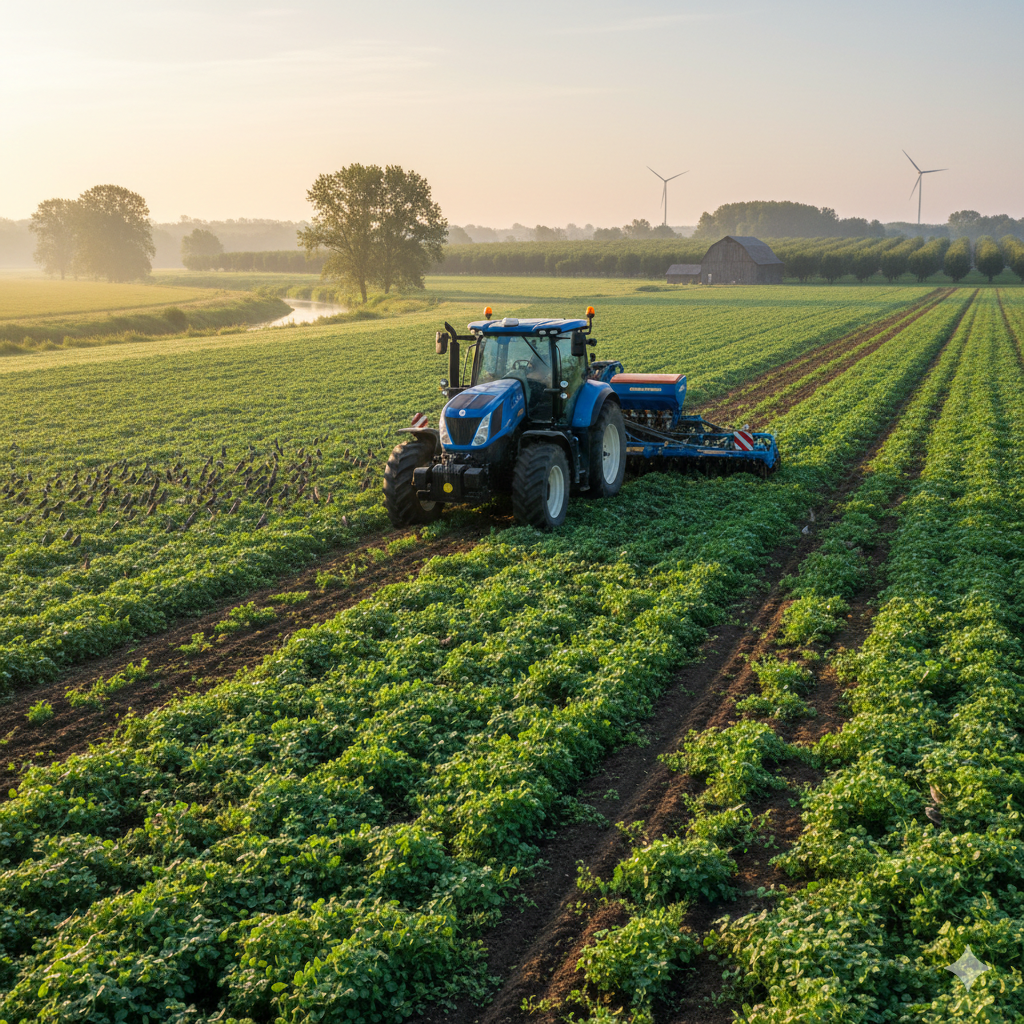
The corporate transition into 2026 marks a fundamental pivot in the global sustainability landscape, characterized by a decisive shift from “ambition and reporting” toward “execution and measurable business value.” As the initial wave of net-zero pledges matures, the focus for C-suite executives and sustainability managers has expanded beyond simple decarbonization toward the restoration and enhancement of the biological systems that underpin global economic stability. This evolution, termed the “nature-positive” transition, recognizes that achieving net-zero emissions is technically and economically impossible without a massive scaling of regenerative land use practices. Within this context, land is no longer viewed merely as a site for extractive production or a passive carbon sink, but as a strategic natural capital asset whose health dictates supply chain resilience, regulatory compliance, and long-term enterprise value.
The geopolitical and macroeconomic climate of 2026 further accelerates this trend. Following the landmark outcomes of COP30 in Belém, which underscored the “implementation imperative,” global finance is increasingly flowing toward nature-based solutions. Rapid read-outs of market sentiments indicate that sustainability is shifting from a marketing story to a core operating system. In a resource-constrained, uncertain world, circularity and regenerative logic are becoming core strategic levers for resilience, cost control, and growth.
The Structural Transition of 2026: From Declaration to Operating System
The year 2026 represents the “credibility test” for corporate sustainability. While the preceding years were defined by the proliferation of frameworks and voluntary pledges, the current landscape is one of execution and financial realism. Business leaders are no longer asking whether sustainability fits into their plans; they are embedding it into their core operations because circularity and regeneration are no longer optional in a world where physical climate risks are showing up in core markets.
Strategic focus is now taking precedence over disclosure overload. As regulatory regimes tighten, smarter materiality and sharper reporting are becoming the norm, with a greater reliance on professional judgment over box-ticking compliance. This shift is particularly evident in the way nature and biodiversity are being integrated into financial decision-making. The alignment of the Taskforce on Nature-related Financial Disclosures (TNFD) with the International Sustainability Standards Board (ISSB) has pushed companies to treat biodiversity, water, and land use as material financial risks.
Comparative Evolution of Corporate Sustainability Paradigms
The following data characterizes the shift in strategic priorities between the early net-zero era and the current 2026 regenerative paradigm.
| Feature | 2020–2024 Paradigm (Net-Zero Focus) | 2026 Paradigm (Regenerative/Nature-Positive) |
|---|---|---|
| Primary Objective | Emissions reduction and carbon neutrality | Halting and reversing nature loss; net-positive outcomes |
| Asset Perspective | Land as a production site or passive offset source | Land as a strategic natural capital asset on the balance sheet |
| Regulatory Driver | Voluntary TCFD and initial ESG reporting | Mandatory CSRD/ESRS E4 and TNFD-aligned ISSB reporting |
| Market Tool | Low-quality avoidance offsets (REDD+) | High-integrity removal credits (Biochar, ERW, ARR) |
| Decision Logic | Marketing and CSR alignment | Resilience, risk management, and capital allocation |
| Data Backbone | Estimated Scope 1–3 GHG emissions | Double materiality; geo-spatial ecosystem integrity data |
Defining Regenerative Land Use: Philosophical and Technical Foundations
Regenerative land use is distinguished from traditional sustainable agriculture by its focus on dynamic processes of transformation where systems become self-perpetuating and self-renewing with minimal external inputs. While the concept of sustainability is often understood as an anthropocentric and mechanistic quest to “do less harm,” regenerative approaches center on “doing more good” by fostering positive upward cycles in biodiversity, soil health, and water cycles.
At its semantic core, “regenerative” refers to the capacity to be alive and creative—to create again. In the context of the biosphere, this means humans participating as nature to support the continued co-evolution of ecosystems. For a corporation, this translates to business models that heal rather than steal from the future, eliminating negative externalities and halting the depletion of vital natural assets that provide largely free environmental services to the economy.
The Nature-Positive Goal and COP30 Momentum
The global societal goal for nature is to be “nature-positive” by 2030, which requires halting and reversing nature loss against a 2020 baseline and achieving full recovery by 2050. Delivering this goal requires measurable net-positive biodiversity outcomes through the improvement in the abundance, diversity, integrity, and resilience of species and ecosystems.
COP30 in Brazil catalyzed this movement by establishing the Tropical Forest Forever Facility (TFFF), which secured 5.5 billion dollars in landmark financial commitments to protect and restore the world’s most critical biomes. This has moved nature-positive investing from a niche conversation into the mainstream, with 2026 marking the point where “blue economy” and “green economy” strategies converge into a single, integrated natural capital agenda.
The Regulatory Imperative: CSRD and TNFD Compliance in 2026
For large organizations, regenerative land use has transitioned from a voluntary initiative to a mandatory reporting requirement under the Corporate Sustainability Reporting Directive (CSRD). Specifically, the European Sustainability Reporting Standard (ESRS) E4 establishes rigorous disclosure requirements for biodiversity impacts and dependencies on ecosystem services.
A significant update in 2026 is the streamlining of these standards. To reduce complexity, the total number of data points has been reduced by 68%, focusing instead on “decision-useful” KPIs that relate directly to financial materiality. However, this simplification comes with higher scrutiny: starting in 2026, auditors will challenge “immateriality” claims with greater frequency, particularly for land-intensive sectors.
Double Materiality and Location-Specific Disclosure
A core requirement of the CSRD is the “Double Materiality” assessment. Companies must evaluate “Impact Materiality”—how their activities and value chain affect biodiversity—and “Financial Materiality”—how changes in the state of nature affect the company’s financial performance and enterprise value.
A critical technical shift in 2026 is the requirement for location-specific disclosure. Global aggregates no longer meet disclosure standards for high-risk operations where supply chain impacts on ecosystem services are material. Companies must now provide site-specific information with geographic precision, often requiring geo-coordinates for sites located in or near biodiversity-sensitive areas.
Technical Pathways to Regenerative Land Use
Soil Organic Carbon (SOC) and Agroforestry
Carbon sequestration in soils is a primary mechanism for offsetting climate change while simultaneously improving soil fertility. Established agroforestry systems—which integrate trees, crops, and/or animals—have been shown to significantly outperform conventional plots across all soil health metrics. Research in 2025 revealed that agroforestry systems can maintain soil organic carbon levels 83% higher than conventional monocultures, while doubling microbial biomass and markedly reducing bulk density.
Enhanced Rock Weathering (ERW): Permanent Chemical Removals
One of the most promising technological frontiers in 2026 is Enhanced Rock Weathering (ERW). This process involves crushing silicate rocks (typically basalt) into fine powder and spreading them across farmland or grasslands. When these rocks dissolve, they undergo a chemical reaction that captures atmospheric CO&sub2; and converts it into stable bicarbonate ions, providing permanent storage for over 100,000 years.
Major players like Carbfix have demonstrated that over 95% of injected CO&sub2; mineralizes into solid carbonate within just two years, ensuring total permanence. Pilot projects demonstrate that applying basalt can remove 4–10 tons of CO&sub2; per hectare per year while boosting crop yields by releasing calcium and magnesium into the soil.
Biochar: Engineered Carbon Stability
Biochar is a stable, carbon-rich solid produced through pyrolysis that sequesters carbon for centuries when applied to soil. By 2026, biochar has become a dominant technology in the durable carbon dioxide removal (CDR) market, representing nearly 89.4% of all durable removals actually delivered to date.
Leading projects like Aperam BioEnergia in Brazil have tripled production to 30,000 tonnes annually by 2026, providing a trusted source of high-impact carbon offsets for businesses with hard-to-abate emissions. Biochar commands a premium price of approximately $150 per ton due to its immediate carbon removal impact and measurable soil co-benefits.
Sector-Specific Transformations and Case Studies
Agri-Food: Scaling Regenerative Agriculture
The agri-food sector is leading the transition through landscape-scale interventions to secure future supply chains.
- Unilever: Having implemented regenerative practices across 130,000 hectares by 2024, Unilever aims to cover 1 million hectares by 2030. They have shifted from many small pilots to fewer, larger projects targeting key crops like soybean and rapeseed.
- PepsiCo: Through the “STEP up for Ag” initiative, PepsiCo is strengthening the advisory ecosystems needed to transition 10 million acres by 2030. They provide funding to farmer-facing organizations to accelerate the adoption of sustainable practices.
- Danone: In France, Danone aims to source 100% of ingredients from regenerative agriculture by 2025, while their Horizon Milk brand in the U.S. aims to be carbon positive through these practices.
Mining and Infrastructure: Progressive Restoration
The mining sector is redefining “Good Mining” as the fusion of resource extraction with sustainable practices. This includes “progressive restoration”—the restoration of native flora even before mine closure. Gold Fields utilizes advanced geospatial technologies and satellite monitoring to target operations for minimal impact.
In infrastructure, the revitalization of post-mining areas increasingly utilizes “blue-green infrastructure.” This approach integrates nature-based solutions like wetlands into urban development to manage stormwater and restore degraded urban spaces.
The Financial Case: Natural Capital Accounting (NCA)
For the C-suite, the formal integration of nature into the corporate balance sheet is the most compelling evolution. Natural Capital Accounting (NCA) allows nature to be viewed as a genuine asset that generates value and carries risks.
The 3-Point Pathway: Discover, Quantify, and Recognize
- Discover: Conduct a thorough assessment of natural capital, identifying specific ecosystem services like carbon sequestration or water purification.
- Quantify: Assign economic value to these services. The forestry company Forico demonstrated that assigning monetary values to natural capital revealed that their assets were approximately four times more valuable than what appeared on a traditional balance sheet.
- Recognize: Formally recognize these assets within financial balance sheets, developing innovative nature-based transactions or contracts that align with international standards like IAS 38.
The Market for Environmental Credits
Buyers are increasingly prioritizing high-integrity removals over low-quality avoidance credits.
- ARR Credits: Afforestation, reforestation, and revegetation credits rated BBB+ now command median prices above $35 per ton.
- Biochar/ERW: Durable CDR credits are increasingly favored for their permanence and immediate verification.
- Biodiversity Credits: Emerging as a tool for financing nature-positive outcomes, with countries like Peru and Lebanon launching registries for these assets.
Technology as the Enabler: AI and Digital MRV
The digital revolution in 2026 provides the tools necessary to monitor, report, and verify (MRV) regenerative impacts. Sustainability teams utilize “Agentic AI” for technical tasks such as validating emissions data and modeling scenario-led analysis for capital allocation.
Satellite Monitoring and SQAT
Innovations in Earth Observation are transforming land management. The Soil Quality Analysis Tool (SQAT) combines Copernicus satellite data with autonomous robots to create high-resolution, affordable soil health maps. These maps empower farmers to tailor inputs to the exact needs of the soil, reducing fertilizer runoff and supporting compliance with environmental directives.
Managing Strategic Tensions: Land, Energy, and AI
As organizations embrace regenerative land use, they must navigate competing demands. The rapid build-out of data centers to meet AI demands is putting unprecedented pressure on global water supplies. Research shows that 85% of the world’s largest companies have a significant dependency on nature, yet these dependencies are often overlooked.
Companies must choose when to “sprint, go slow, or take baby steps” based on the materiality of these tensions. Strategic focus over disclosure overload means anchoring climate resilience in core risk management rather than treating it as a separate CSR exercise.
Implementation Strategy for 2026: A Roadmap for Leaders
Phase 1: Foundation and Assessment (Months 1–6)
The
first step is a materiality assessment using the TNFD’s LEAP approach (Locate,
Evaluate, Assess, Prepare). This involves mapping value chain dependencies on nature across
operations and supply chain.
Phase 2: Strategy and Target Setting (Months
6–12)
Organizations should set science-based targets aligned with the
SBTN Land guidance. This includes developing a “Nature-Positive Transition Plan”
that integrates nature risks into the enterprise risk management framework.
Phase 3: Implementation and Scaling (Years
1–3)
Scaling requires multi-year partnerships built on trust and
shared economic value. For agri-food, this means supporting farmers through the 2–4
year transition period required for soil health improvements to materialize.
Phase 4: Disclosure and Verification (Ongoing)
Credible
reporting in 2026 requires independent validation and verification of nature-positive
outcomes. Companies must align reporting with CSRD and TNFD standards, providing transparent
data on habitat restoration and species indicators.
Conclusion: The Resilience Dividend
In 2026, the transition beyond net-zero is a strategic imperative. Regenerative land use offers a unique “resilience dividend”—the ability to restore the natural assets that support global supply chains while meeting stringent regulatory and financial demands. The organizations that will thrive are those that embed regenerative logic into their core operating systems, valuing nature as a foundational asset for future growth.